
A Decade of Gut Microbiota Research: What Bibliometric Analysis Reveals About Where the Field Is Heading
Estimated read time: 8–9 min
Pull up ten years of gut microbiota literature and ask a simple question — where has the field‘s attention actually gone? — and you get an answer that‘s hard to argue with, because it isn‘t based on anyone‘s impression of the field. It‘s based on 89,512 articles.
That‘s the dataset behind a comprehensive bibliometric analysis published in Arquivos de Gastroenterologia in September 2025, covering everything indexed in the Web of Science Core Collection on gut microbiota between 2015 and 2024 [1]. The headline number: publication output grew roughly 5.82-fold over the decade. But the more useful story isn‘t the growth curve itself — it‘s what the keyword patterns inside that growth reveal about where the field‘s center of gravity actually sits, which regions are asking which questions, and where the evidence is thinner than the volume of papers might suggest.
We read through the study‘s methodology and findings with an eye toward what‘s actually useful for study design, not just what‘s interesting as trivia. Here‘s what we took from it.
Why keyword bibliometrics is worth taking seriously
Skeptical of what a keyword-counting exercise can really tell you? Fair. But the strength of this kind of analysis isn‘t in any single number — it‘s in triangulating across methods that each answer a different question about the same dataset [1]:
- Co-occurrence analysis shows which keywords cluster together most often, visualized as a heatmap — a snapshot of what the field currently treats as related.
- Principal component analysis (PCA) compresses those relationships into two dimensions, revealing whether topics form distinct thematic camps or blur together.
- Burst detection, using Kleinberg‘s algorithm, flags keywords with a sudden, sustained spike in usage — the signal that separates what‘s trending from what‘s just large.
That last distinction matters more than it sounds. A keyword can be enormous in raw volume and still be flat — old, saturated territory. A keyword can be comparatively small and still be bursting — the early edge of where the field is moving. If you‘re scoping a new project, the second kind of signal is usually the more actionable one.
The finding that showed up everywhere: diet
Run the co-occurrence analysis, and one keyword keeps forcing its way to the center: diet. Behind the expected core terms, the strongest associations in the dataset were between "intestinal" and "microbiota" (441,534 co-occurrences), and close behind, "diet" paired with "gut" (228,768 co-occurrences) and "diet" paired with "microbiota" (227,185 co-occurrences) [1]. In the PCA, dietary and health-related keywords formed their own distinct cluster, structurally separate from the disease-and-inflammation cluster — suggesting the field isn‘t treating diet as a side variable tacked onto disease research. It‘s organizing itself around a gut-diet-health axis in its own right [1].
A secondary search isolating "diet AND intestinal" pulled 28,133 records on its own, and the pattern held there too: strong links to supplementation, growth performance, and host metabolism outcomes — not just correlational observation, but mechanistic work on how dietary components reshape microbial composition and function [1].
The practical read: if your study sits inside gut-diet-mechanism territory, you‘re working in the field‘s most crowded neighborhood. That‘s not a reason to avoid it — it‘s a reason to be precise about what makes your angle new, because volume this high means differentiation has to come from somewhere sharper than another diet-diversity correlation.
What‘s actually accelerating right now
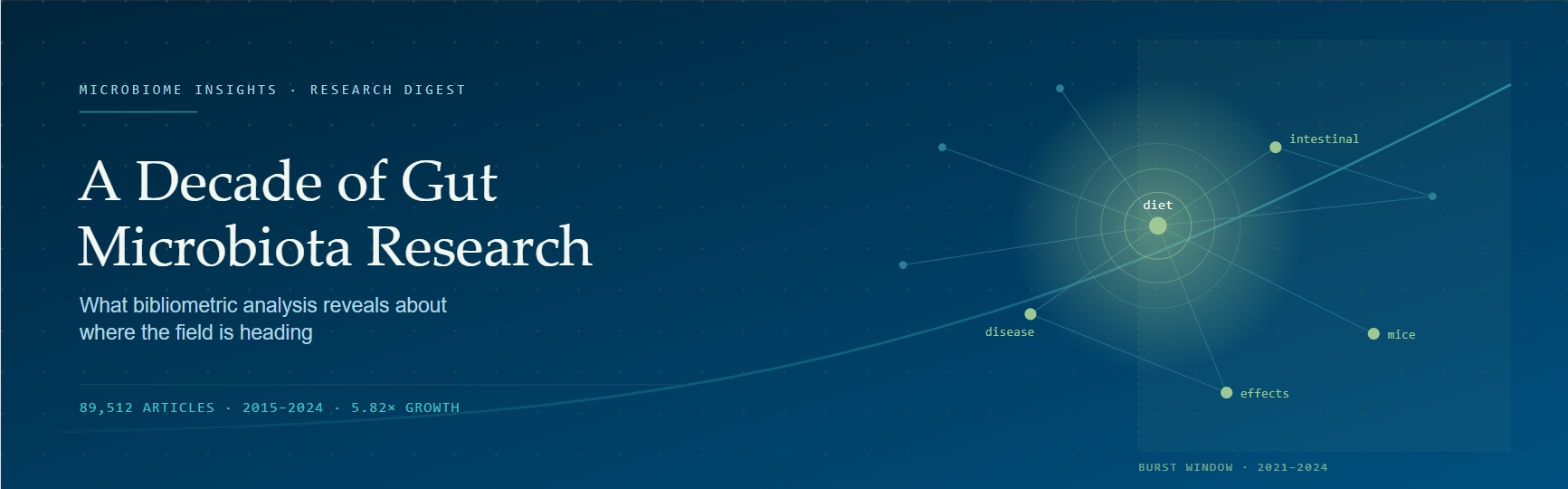
Volume tells you where the field has been. Burst detection tells you where it‘s moving. After filtering out the core search terms, the keywords with the strongest, most recent bursts were intestinal, disease, mice, diet, effects, and health — all bursting within the 2021–2024 window [1]. In the diet-focused secondary analysis, growth, fed, performance, and protein showed the sharpest bursts, reflecting a wave of interventional, physiology-outcome-focused animal studies [1].
One detail worth sitting with: "mice" is still bursting through 2024. That‘s a signal the field‘s mechanistic work hasn‘t fully migrated to human cohorts or multi-omics platforms yet — a lot of the causal groundwork is still happening in animal models. For anyone planning a human intervention study, that‘s not a footnote; it‘s a real translatability gap worth naming explicitly rather than assuming away.
Geography changes the question being asked
One of the more underused strengths of a dataset this large is that it lets you compare research emphasis across regions, not just track the field as a single global conversation. By volume, China leads, followed by the United States, Italy, and Germany — with Japan, South Korea, and India leading within Asia, and Brazil leading in Latin America [1].
The regional split isn‘t just a publication-count curiosity — it tracks with genuinely different dietary and cultural research contexts. Japanese groups have concentrated on fermented foods like natto and miso; Chinese research draws heavily on traditional Chinese medicine and medicinal cuisine; Korean work centers on kimchi and doenjang; and Latin American groups, especially in Brazil and Mexico, have focused on kefir and native fruits such as açaí, cashew, and banana [1]. In other words, "gut-diet-health" isn‘t one universal research question — it‘s several regionally specific ones, shaped by what people are actually eating. A finding calibrated to one population‘s diet won‘t necessarily transfer cleanly to a study population eating a structurally different one, and that‘s worth building into design assumptions rather than discovering in the discussion section.
Where the field is thinner than its size suggests
The most useful part of a bibliometric analysis is often what it shows is underexplored relative to the field‘s overall bulk. A few gaps the study‘s discussion section calls out directly:
- Postbiotics and next-generation probiotics. The literature shows a clear directional shift away from traditional probiotic and fermented-food framing and toward postbiotics, next-generation candidates like Akkermansia muciniphila and Faecalibacterium prausnitzii, and gut virome interactions [1]. That trajectory has kept moving in 2026: recent reviews now frame next-gen probiotics explicitly around personalized, multi-omics-informed therapeutic design rather than one-size-fits-all strain selection [2].
- Multi-omics depth. The authors are upfront that keyword-based co-occurrence analysis can‘t fully capture the growing volume of metagenomic, metabolomic, and multi-omics work — meaning the field‘s real complexity is likely understated by any purely text-mining approach, including this one [1].
- Causality, not just correlation. Despite the sheer volume of association-type findings, establishing clear cause-and-effect relationships between specific microbial shifts and health outcomes remains an open, unresolved challenge [1].
- A shared definition of a "healthy" gut microbiome. Still unsettled — and it quietly complicates how diversity-based findings get compared across studies that may be implicitly using different reference standards without saying so [1].
What this means for how you scope the next study
A few concrete takeaways for anyone designing new work in this space:
- Diet-microbiota work is crowded — lead with mechanism, not correlation. With this much volume already in the space, another diet-diversity association study needs a genuinely differentiating angle: mechanism, a specific population, or multi-omics depth.
- Name the animal-model gap instead of assuming it away. If human translatability is part of your study‘s value proposition, the field‘s continued reliance on mouse models is a gap worth addressing head-on in your framing.
- Treat population and dietary context as a design variable, not a caveat. The regional clustering here is a quantitative echo of something study design should account for from the outset, not disclose as a limitation afterward.
- Postbiotics and next-gen probiotics remain comparatively open territory. Relative to where clinical interest is heading, this is still a space where a smaller, focused study can make a real contribution rather than adding to an already saturated pile.
The honest caveat
Bibliometric analysis has a built-in limitation worth naming: it shows you where attention has gone, not necessarily where the truth is. A bursting keyword doesn‘t mean the underlying science is settled — sometimes it means the opposite, that the field is still actively arguing about it. What this kind of analysis is genuinely good for is orientation: spotting saturated versus underexplored territory, and checking whether your study design reflects the field‘s actual trajectory rather than a five-year-old mental model of where things stand.
The full dataset and methodology are open access, and worth a direct read if you‘re scoping dietary-intervention or diversity-focused work for your next research cycle [1].
Related reading: For a closer look at how diversity is actually measured and reported in microbiome studies, see our earlier piece on alpha and beta diversity metrics.
References
- Ogasawara N. Evolving Trends and Emerging Themes in Gut Microbiota Research: A Comprehensive Bibliometric Analysis (2015–2024). Arq Gastroenterol. 2025;62:e25023. doi:10.1590/S0004-2803.24612025-023
- Jadhav SD, Nimbalkar MS. Next-Generation Probiotics: From Traditional Strains to Personalized Therapeutics. Mol Nutr Food Res. 2026;70(1):e70339. doi:10.1002/mnfr.70339